
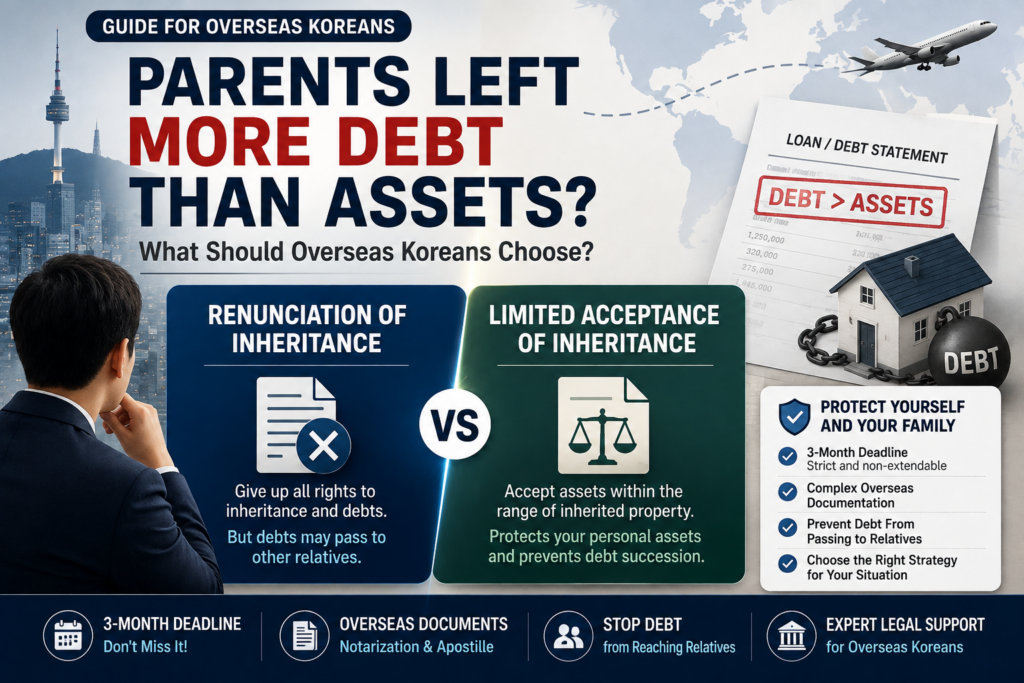
- If Your Parents Left More Debt Than Assets, Which Option Should Overseas Koreans Choose?
- Renunciation of Inheritance vs. Limited Acceptance
- Renunciation of Inheritance
- Limited Acceptance of Inheritance
- Practical Strategy Used Most Frequently
- Three Practical Challenges Faced by Overseas Koreans
- 1. The Three-Month Deadline
- 2. Overseas Documentation Requirements
- 3. Coordinating Multiple Heirs
- Which Option Should You Choose?
- Case A: Other First-Ranking Heirs Live in Korea
- Case B: You Are the Sole Heir (or All Heirs Live Overseas)
- Case C: You Do Not Know Your Parents’ Assets or Debts
- Practical Procedure for Overseas Koreans
- Step 1
- Step 2
- Step 3
- Step 4
- Step 5
- Step 6 (Limited Acceptance Only)
- Common Documents Required by Country
- United States / Canada / Australia
- China / Vietnam / Other Non-Hague Countries
- Practical Checklist for Overseas Koreans
- Conclusion
If Your Parents Left More Debt Than Assets, Which Option Should Overseas Koreans Choose?
For overseas Koreans, permanent residents, and foreign citizens living abroad, the passing of a parent in Korea is emotionally devastating on its own. Unfortunately, after the funeral is over and life overseas resumes, many families face another unexpected challenge: discovering that their parents left behind more debt than assets.
It is not uncommon for heirs to learn about outstanding bank loans, tax liabilities, or personal debts only after beginning the process of settling bank accounts or transferring real estate.
Under Korean inheritance law, an heir generally has three months from the date they become aware of the commencement of inheritance to file either a Renunciation of Inheritance or a Limited Acceptance of Inheritance with the Korean Family Court.
While this deadline is manageable for those living in Korea, overseas Koreans—including permanent residents and foreign citizens whose Korean resident registration has been cancelled—often encounter significant practical difficulties before they can even decide which option is appropriate.
Typical questions include:
- If I renounce my inheritance, will the debt pass to my children or relatives in Korea?
- I am now a foreign citizen. How do I prepare notarized documents without a Korean resident registration?
- What documents must be notarized, apostilled, or authenticated by a Korean consulate?
This guide explains the practical issues overseas Koreans face and outlines the safest legal strategies for minimizing liability while properly resolving inheritance matters in Korea.
Renunciation of Inheritance vs. Limited Acceptance
Both procedures protect heirs from inheriting excessive debt, but they produce very different legal consequences.
Renunciation of Inheritance
By renouncing inheritance, the heir is legally treated as though they never became an heir in the first place.
The procedure is relatively straightforward and ends once the Family Court approves the application.
However, one important consequence is that the inheritance—including any debts—passes to the next-ranking heirs under Korean law.
Limited Acceptance of Inheritance
Under Limited Acceptance, the heir accepts the inheritance only to the extent of the inherited assets.
Personal assets remain protected even if the deceased owed more than they owned.
Unlike renunciation, however, Limited Acceptance requires additional procedures after court approval, including:
- Public notice to creditors;
- Individual notification of known creditors; and
- Distribution and settlement of inherited assets.
Although more complex, Limited Acceptance generally prevents debts from cascading down to lower-ranking relatives.
Practical Strategy Used Most Frequently
In practice, Korean lawyers commonly recommend the following approach:
- One first-ranking heir files for Limited Acceptance, while
- All remaining first-ranking heirs file Renunciation of Inheritance.
This combination protects the family from unexpected debt succession while minimizing administrative burden.
| Renunciation | Limited Acceptance | |
|---|---|---|
| Legal Effect | Gives up heir status entirely | Accepts inheritance only within inherited assets |
| Liability | No liability, but debts pass to next-ranking heirs | Personal assets protected |
| Effect on Other Relatives | Debt may pass to lower-ranking heirs | Prevents debt succession |
| Complexity | Relatively simple | More procedural requirements |
| Generally Recommended For | Where another heir is handling Limited Acceptance | Sole heirs or where family debt succession should be prevented |
Three Practical Challenges Faced by Overseas Koreans
1. The Three-Month Deadline
The statutory three-month period is often the greatest obstacle.
For overseas heirs, obtaining official documents, arranging notarization, apostilles, translations, and international delivery can consume much of the available time.
If the court concludes that the application was filed after the statutory deadline, the heir may unintentionally become responsible for all inherited debts.
Proper evidence establishing when the heir first became aware of the inheritance is therefore extremely important.
2. Overseas Documentation Requirements
Foreign citizens and overseas Koreans whose Korean resident registration has been cancelled cannot simply submit Korean identification documents.
Instead, they frequently must prepare:
- Proof of overseas residence;
- Signature certificates;
- Powers of Attorney;
- Identity certificates (where names differ); and
- Apostilles or Korean consular authentication.
Even small discrepancies between Korean and English names, translation errors, or incorrect notarization formats may result in court correction orders (“supplementation orders”), creating significant delay and risking expiration of the statutory filing period.
Experienced legal assistance is often essential.
3. Coordinating Multiple Heirs
Inheritance decisions become even more complicated when some heirs reside in Korea while others live abroad.
If one heir renounces inheritance without considering the overall inheritance structure, debts may unexpectedly pass to lower-ranking family members.
Because one person’s decision directly affects other relatives, overseas inheritance matters require coordinated legal planning rather than isolated filings.
Which Option Should You Choose?
Case A: Other First-Ranking Heirs Live in Korea
Recommended Strategy: Limited Acceptance + Renunciation
Where another first-ranking heir resides in Korea, it is generally most efficient for that heir to file for Limited Acceptance while the overseas heir files Renunciation.
The Korean heir can more easily manage:
- creditor notices;
- newspaper publication;
- settlement procedures; and
- court correspondence.
This approach significantly reduces both administrative burden and legal costs.
Case B: You Are the Sole Heir (or All Heirs Live Overseas)
Recommended Strategy: Limited Acceptance
If you are the only heir—or all immediate heirs reside abroad—Limited Acceptance is usually the safest choice.
Simply renouncing inheritance does not eliminate the deceased’s debts.
Instead, those obligations may pass to lower-ranking relatives in Korea, including:
- uncles;
- aunts;
- cousins; or
- other statutory heirs.
Limited Acceptance prevents this chain of succession and provides a cleaner resolution for the entire family.
Case C: You Do Not Know Your Parents’ Assets or Debts
Recommended Strategy: One-Stop Inheritance Service + Special Limited Acceptance
Many overseas Koreans have had limited contact with family in Korea for years and may not know the deceased’s financial circumstances.
The first step should be using the Korean government’s One-Stop Inheritance Information Service, which allows heirs to check:
- bank accounts;
- real estate;
- taxes;
- pensions; and
- certain debts.
If substantial debts are discovered after the normal three-month filing period, Korean law may allow a Special Limited Acceptance, provided the heir can demonstrate that they did not know—and could not reasonably have known—that the debts exceeded the assets.
Because courts apply this exception strictly, careful preparation of supporting evidence is critical.
Practical Procedure for Overseas Koreans
Step 1
Prepare the required documents, including powers of attorney, proof of residence, and signature certificates, and have them notarized locally.
Step 2
Obtain either:
- an Apostille (for Hague Convention countries); or
- Korean consular authentication (for non-Hague countries).
Step 3
Send the original documents to Korea and prepare certified Korean translations where necessary.
Step 4
File the application for Renunciation or Limited Acceptance with the Family Court having jurisdiction over the deceased’s last Korean address.
Applications generally must be submitted within the statutory three-month period.
Step 5
Receive the Family Court’s decision approving the application.
Step 6 (Limited Acceptance Only)
After approval:
- publish notice to creditors;
- notify known creditors individually; and
- complete settlement of inherited assets.
Common Documents Required by Country
United States / Canada / Australia
- Proof of Residence
- Signature Certificate
- Certificate of Identity (if names differ)
- Power of Attorney
- Apostille
China / Vietnam / Other Non-Hague Countries
- Proof of Residence
- Signature Certificate
- Power of Attorney
- Authentication by local authorities
- Korean Consular Authentication
Practical Checklist for Overseas Koreans
- Confirm the deceased’s date of death and the date you first learned of the inheritance.
- Investigate the deceased’s assets and debts.
- Confirm your legal status (overseas Korean, permanent resident, or foreign citizen).
- Determine whether other first-ranking heirs exist and coordinate inheritance strategy.
- Confirm whether your country issues Apostilles.
- Prepare overseas notarization documents.
- Verify consistency between your Korean and English names.
- Allow sufficient time for international shipping, translation, and court filing.
- Prepare for possible court correction requests.
- If filing Limited Acceptance, plan for creditor notice and settlement procedures after court approval.
Conclusion
Inheritance involving overseas Koreans is significantly more complicated than a domestic inheritance case.
International documentation, notarization, apostilles, translations, strict statutory deadlines, and coordination among heirs all require careful planning.
Selecting the appropriate legal strategy at the outset—whether Renunciation of Inheritance, Limited Acceptance, or a combination of both—can prevent unnecessary liability and protect not only your own assets, but also your family’s legal interests.
For overseas Koreans, obtaining experienced legal advice early in the process is often the safest and most cost-effective approach.