
South Korea continues to attract global businesses thanks to its strong manufacturing base, sophisticated consumer market, and strategic position as a gateway to Asia. However, once a company decides to establish a presence in Korea, one of the first practical challenges is determining which visa best fits its business structure and expansion strategy.
A poorly planned visa strategy can delay market entry even after a Korean subsidiary or branch has been established. It is not uncommon for immigration authorities to request additional documentation regarding the source of investment funds, business substance, or local employment, resulting in significant delays to the company’s launch schedule.
This article provides practical legal guidance on selecting the appropriate visa for companies planning to expand into South Korea.
D-8 vs. D-9 vs. E-7: Key Differences Explained
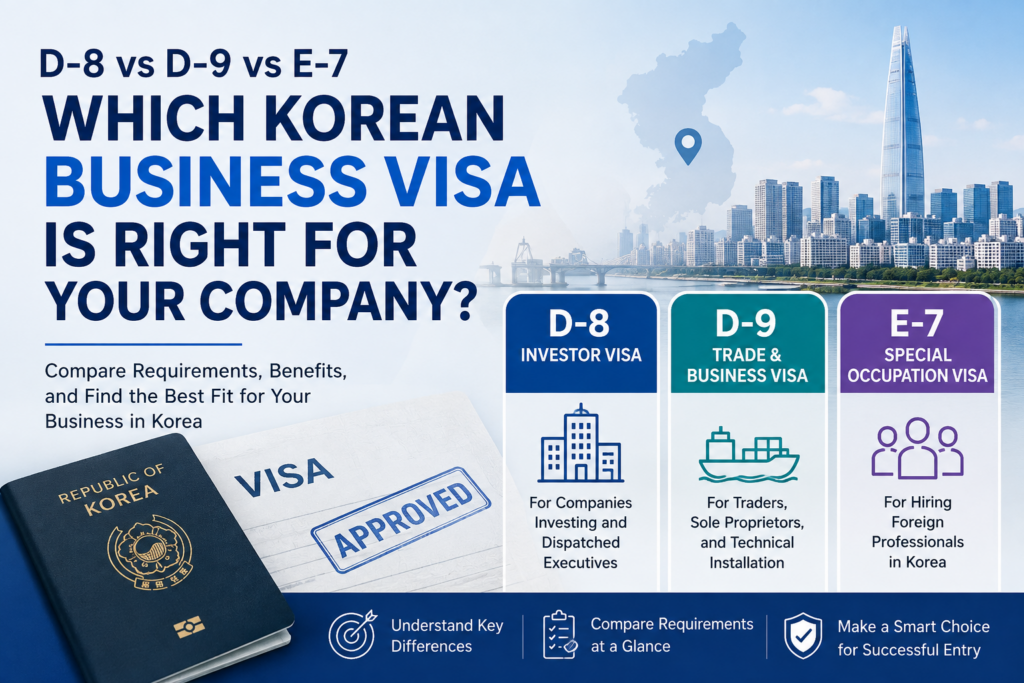
Foreign companies entering Korea generally choose among the D-8 (Investor Visa), D-9 (Trade & Business Visa), and E-7 (Special Occupation Visa) depending on their investment structure, business model, and personnel needs.
Each visa differs significantly in terms of investment requirements, eligible business structures, and qualification criteria. Selecting the appropriate visa at the outset is essential for a successful market entry.
| Category | D-8 (Corporate Investment) | D-9 (Trade & Business) | E-7 (Special Occupation) |
|---|---|---|---|
| Purpose | Establish a Korean corporation and allow investors or dispatched employees to reside in Korea | Operate certain business activities, trade, or dispatch installation/technical personnel | Hire foreign professionals to work for a Korean company |
| Business Structure | Korean corporation | Five subcategories (trade, installation, sole proprietorship, etc.) | No restriction |
| Eligible Applicants | Foreign investors and employees dispatched from headquarters | Sole proprietors, traders, installation engineers | Foreign professionals with specialized knowledge or skills |
D-8 Investor Visa: Types, Requirements, and Application Process
| Category | Investment Target | Core Requirements |
|---|---|---|
| D-8-1 | Korean corporation | Minimum investment of KRW 100 million and at least 10% equity ownership |
| D-8-2 | Venture company | Certified venture company or approved technology evaluation |
| D-8-3 | Sole proprietorship | Minimum investment of KRW 300 million and joint ownership with a Korean national |
| D-8-4 | Technology startup | Degree plus intellectual property, minimum 60 points under the startup evaluation system |
The D-8 Investor Visa allows not only foreign investors but also key personnel dispatched from the overseas headquarters to reside and work in Korea. Companies with successful business operations may also enjoy a smoother pathway toward long-term residence (F-2) and permanent residency (F-5).
On the other hand, the application process is documentation-intensive, and the number of eligible dispatched employees may be limited depending on the amount of investment.
Key Immigration Review Criteria
Immigration authorities generally evaluate:
- Whether at least KRW 100 million has been lawfully invested under the Foreign Investment Promotion Act;
- Whether the investment funds originated from legitimate overseas sources and can be fully documented;
- Whether the Korean business has genuine physical operations rather than being merely a paper company;
- Whether the proposed business demonstrates commercial viability and the potential to create local employment.
Application Process
- File a foreign investment notification and open an investment account with a Korean foreign exchange bank.
- Transfer the investment funds into Korea and complete the capital contribution.
- Register the foreign-invested company and obtain a Korean business registration certificate.
- Apply for the D-8 visa by submitting the business plan, investment documentation, and supporting materials to the Korean Immigration Office or the appropriate Korean consulate.
Obtaining a D-8 visa involves far more than simply incorporating a company and investing capital. The investment structure, documentation, and timing must all be carefully coordinated from the earliest planning stage through the final immigration review. A well-designed legal strategy substantially improves the likelihood of approval.
D-9 Trade & Business Visa: Categories and Core Requirements
The D-9 visa is generally used for businesses that do not fall under the standard foreign investment framework. It is commonly utilized by sole proprietors, international traders, and technical personnel responsible for installing or servicing imported industrial equipment.
| Category | Eligible Applicant | Core Requirements |
|---|---|---|
| D-9-1 | Registered trader | Points-based evaluation considering trade performance, professional experience, and business activities |
| D-9-2 | Installation and maintenance engineers | Dispatch for installation or servicing of imported industrial equipment |
| D-9-3 | Supervisors for shipbuilding or industrial projects | Personnel dispatched by project owners or designated engineering firms |
| D-9-4 | Foreign sole proprietor | Minimum investment of KRW 300 million, proof of business substance, and operational feasibility |
| D-9-5 | International graduates starting a business | Minimum investment of KRW 100 million plus academic or OASIS program qualifications |
The D-9 visa allows foreign nationals to operate businesses in Korea without establishing a foreign-invested corporation under the D-8 framework. It is also widely used when overseas manufacturers dispatch engineers to install, commission, or maintain equipment sold to Korean customers.
However, sole proprietors generally face a higher minimum investment threshold than D-8 applicants, and visa renewals often require substantial proof of actual business operations, including sales revenue and trade performance.
Unlike ordinary investment visas, D-9 applications frequently require applicants to demonstrate:
- the legitimacy of international supply or service contracts;
- the necessity of dispatching specialized technical personnel;
- ongoing commercial activities and trade performance.
Because immigration authorities carefully examine these factors, legal planning from the contract negotiation stage is often critical to a successful application.
E-7 Special Occupation Visa: Categories and Core Requirements
| Category | Eligible Applicant | Core Requirements |
|---|---|---|
| E-7-1 | Professional occupations (67 designated occupations) | Bachelor’s degree plus one year of relevant experience, or six years of experience; foreign hires generally limited to 20% of Korean employees |
| E-7-2 | Semi-professional occupations (10 designated occupations) | Relevant associate degree or work experience, minimum income threshold, and recommendation from the relevant government authority |
| E-7-3 | Skilled workers (8 designated occupations) | Professional qualifications or work experience, skills verification, and government recommendation |
| E-7-4 | Skilled workers under the points system | Existing lawful employment in Korea under certain visa categories, with points awarded based on income, Korean language ability, education, age, and other factors |
In addition, Korea has introduced the E-7-S special program for highly skilled professionals and high-income workers in advanced technology industries.
The E-7 visa enables Korean companies to directly hire highly qualified foreign professionals without requiring foreign investment.
However, immigration authorities carefully protect the domestic labor market by imposing occupation-specific hiring restrictions and closely reviewing whether the employer genuinely requires foreign expertise that cannot reasonably be filled by the local workforce.
The review process typically examines:
- the foreign employee’s qualifications and professional experience;
- the employer’s financial stability;
- the employer’s ratio of Korean employees;
- whether hiring a foreign national is genuinely necessary from both a legal and business perspective.
Because immigration officers scrutinize these factors in detail, companies should develop a well-supported legal justification before executing employment agreements and submitting visa applications.
Which Visa Is Right for Your Business?
Selecting the appropriate visa depends primarily on how your company intends to enter the Korean market and how you plan to deploy personnel.
If your company plans to establish a Korean subsidiary, invest capital, and dispatch executives or key personnel from overseas headquarters:
→ D-8 Investor Visa
If your objective is to operate as a sole proprietor, conduct international trade, or dispatch engineers to install and maintain industrial equipment:
→ D-9 Trade & Business Visa
If your Korean operation intends to directly employ foreign professionals with specialized expertise:
→ E-7 Special Occupation Visa
Each visa category is governed by distinct legal standards regarding investment structure, corporate form, occupation codes, employment qualifications, and immigration documentation. Proper planning at the earliest stage can significantly reduce regulatory risk and help ensure a smooth and timely market entry into South Korea.